
EBITDA Multiple for Construction Companies 2026: The Complete Guide
The EBITDA multiple for construction companies in 2026 ranges from 2X to 12X — a spread wide enough to mean the difference between a life-changing exit and a deeply disappointing one. If you own a construction business and are thinking about what it’s worth, the number that matters most is not revenue. It is not even EBITDA alone. It is which sub-sector you operate in, how much of your revenue is recurring, and whether your operations are built around Proprietary Intelligence or generic project management tools.
Construction is one of the most fragmented industries in America and one of the most misunderstood from a valuation standpoint. Ask ten construction owners about the EBITDA multiple for construction companies and you will get ten different answers — most of them based on outdated revenue multiples that bear no relationship to what buyers are actually paying in 2025–2026 transactions.
This guide breaks down the EBITDA multiple for construction companies by sub-sector, explains what drives the gap between a 3X and a 10X outcome, and gives you the framework to understand exactly where your business sits on the valuation spectrum.
The Construction M&A Landscape in 2026
The construction sector — spanning general contractors, specialty trades, infrastructure contractors, and construction services — remains one of the most actively consolidated segments in the lower middle market. Private equity identified construction as a prime consolidation opportunity for the same reasons it targeted HVAC, roofing, and plumbing: highly fragmented ownership, non-discretionary demand drivers, significant recurring revenue potential, and real operational improvement upside.
Several dynamics are shaping construction M&A and the EBITDA multiple for construction companies heading into the second half of 2026:
Infrastructure investment tailwind. The Infrastructure Investment and Jobs Act (IIJA) continues driving substantial public construction spending. Buyers specifically value the demand visibility this creates for infrastructure-adjacent contractors — translating directly into higher acquisition multiples for civil and infrastructure-focused businesses.
Specialty trades consolidation. PE-backed platforms in electrical, mechanical, fire protection, and plumbing have been among the most active acquirers in the sector. Their focus is unmistakable: recurring inspection and service revenue. Pure construction general contractors without a service division simply do not fit the thesis these platforms are executing.
Technology bifurcation. Buyers are now actively distinguishing between construction companies using generic software and those with Proprietary Intelligence — autonomous estimating systems, predictive project scheduling, and data-driven cost control. The valuation gap between these two groups is widening with every deal cycle.
Labor shortage pressure. The construction industry needs to attract hundreds of thousands of new workers in 2026. Businesses that have systematized labor management, documented training, and reduced owner-dependent operations command premium multiples because they have solved the problem buyers fear most.
Understanding this landscape is foundational to any construction business exit strategy. The market rewards businesses that look less like construction companies and more like essential services platforms.
EBITDA Multiple for Construction Companies by Sub-Sector
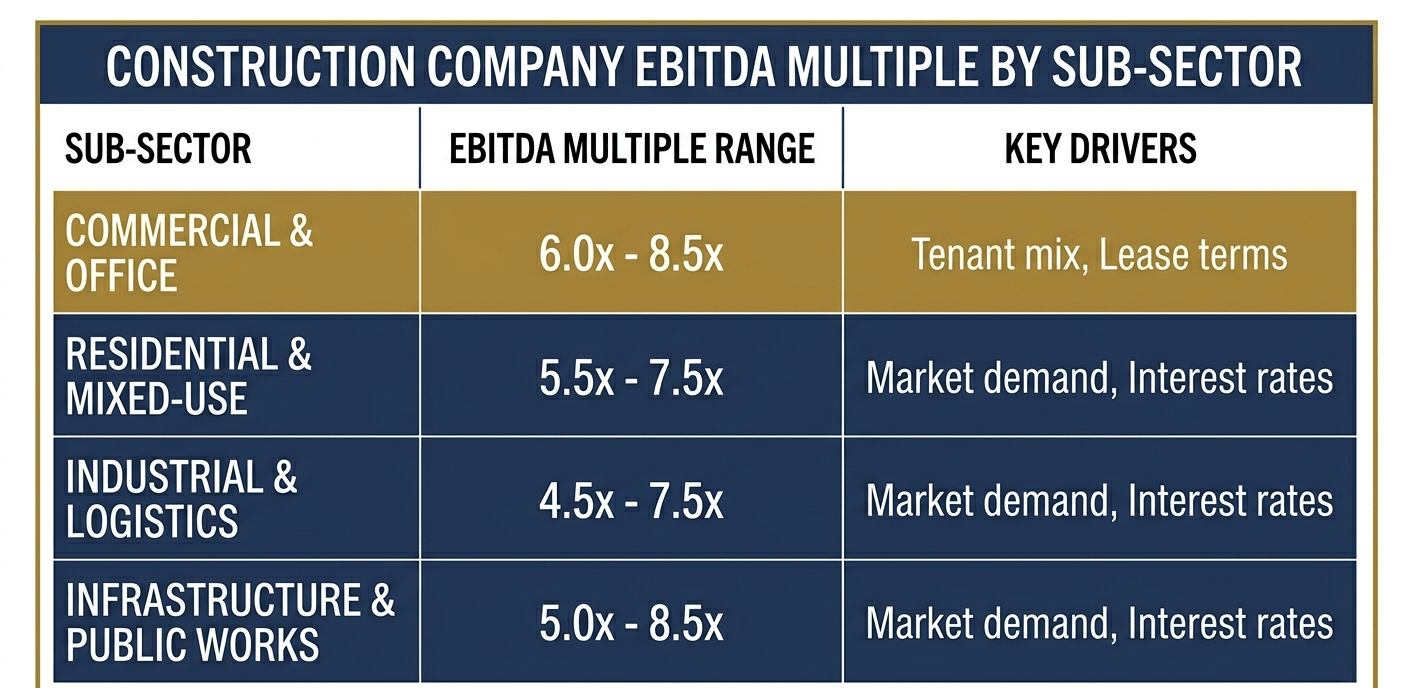
This is the data most construction owners never see clearly. The EBITDA multiple for construction companies is not primarily determined by company size. It is determined by sub-sector, revenue predictability, and operational infrastructure. Here is where each category trades in 2025–2026 transaction data:
| Company Profile | Typical Multiple | Key Driver |
|---|---|---|
| Residential GC / homebuilder (project-only) | 2X–4X EBITDA | Project revenue only, no recurring income, owner-dependent |
| Commercial general contractor (mid-market) | 3X–5X EBITDA | Longer contracts, some recurring service potential |
| Specialty trades (HVAC / plumbing / electrical) | 4X–7X EBITDA | Recurring service revenue potential, essential nature, PE interest |
| Infrastructure / civil construction | 4X–7X EBITDA | Government contracts, long-term revenue visibility |
| Fire protection and life safety | 6X–10X EBITDA | Compliance-driven inspection contracts, recurring revenue |
| Specialty tech-enabled construction services | 7X–12X EBITDA | Proprietary Intelligence, recurring revenue, defensible moat |
The hierarchy reveals a clear pattern. The further a construction business moves from pure project revenue toward recurring revenue and Proprietary Intelligence, the higher the EBITDA multiple for construction companies. A fire protection company at 8X EBITDA is not getting that multiple because it builds better. It is getting it because compliance-driven inspection and testing contracts create genuinely non-discretionary recurring income that buyers price like subscription revenue.
See also: EBITDA Multiples for Trucking Companies — How the Numbers Compare
Why Specialty Contractors Command Higher Multiples Than General Contractors
The valuation gap between a specialty contractor and a general contractor is one of the most important — and least understood — dynamics in the construction M&A market.
General contracting generates significant revenue but presents a fundamentally different buyer experience. GC revenue is lumpy, project-dependent, and requires deep owner involvement in estimating, client relationships, and subcontractor coordination. The skills that make a general contractor successful often walk out the door with the founder. That key-man risk is the single biggest suppressor of the EBITDA multiple for construction companies in the lower middle market.
Specialty contractors — electrical, mechanical, plumbing, fire protection — operate in the same construction category but carry a critically different revenue potential: the service and maintenance revenue stream that follows every installation. An electrical specialty contractor who installs a commercial building’s systems can offer ongoing testing, maintenance, and upgrade services for the life of that building. That recurring revenue, layered on top of installation work, transforms the buyer’s classification from “construction company” to “essential services platform.”
Private equity firms have spent the last five years executing exactly this thesis — acquiring specialty trades businesses with recurring service revenue and building them into multi-trade platforms. The acquisition activity speaks directly to specialty contractor valuation: buyers understand that installation revenue brings in the customer and service revenue creates the valuation premium.
If you are wondering how to sell my construction company at the top of the range, the most important question is whether your business has begun building a recurring service revenue layer on top of project work.
How Technology Drives the EBITDA Multiple for Construction Companies Higher
Construction technology has evolved rapidly — and the valuation gap between technology-enabled and technology-agnostic companies is widening with each deal cycle. Building Information Modeling (BIM), drone-based site monitoring, AI-powered estimating, and autonomous project scheduling are becoming baseline expectations for premium-tier buyers. But deploying off-the-shelf software is not the same as having Proprietary Intelligence.
Proprietary Intelligence means estimating systems trained on your specific cost history and market conditions. It means predictive project scheduling that learns from your completed jobs. It means subcontractor performance intelligence that routes work to optimal crews based on documented performance data. These systems create competitive moats that buyers specifically pay premiums for — because a competitor cannot replicate them by simply purchasing the same software license.
Technology integration that reduces audit risk and improves EBITDA margins by 3–5 percentage points directly translates into multiple expansion. A specialty contractor with 10% EBITDA margins and Proprietary Intelligence is valued fundamentally differently than one with 10% EBITDA margins and generic project management tools. Same profitability percentage. Materially different exit outcome.
See also: What Is Proprietary Intelligence and How Does It Affect Your Valuation?
What Buyers Are Specifically Paying Premiums For in 2026
Based on current acquisition activity and stated buyer criteria across the construction M&A market, here is what consistently moves a construction company from the middle of the multiple range to the top:
Recurring Service Revenue
Any construction business that has layered service contracts, inspection agreements, or maintenance programs on top of installation work commands a meaningful premium. Even a service division representing 20–30% of total revenue can shift the EBITDA multiple for construction companies by 1X–2X. Buyers apply materially higher multiples to service revenue than to project revenue — and they blend the two to arrive at your overall valuation.
See also: How a Service Division Changes Your Construction Business Exit Strategy
Owner-Independent Operations
Documented estimating processes, functional project management systems, and a management team capable of executing without the founder present reduce the key-man risk that is the primary valuation suppressor across all construction company valuation scenarios. Buyers are not just buying your EBITDA — they are buying their ability to run and grow the business after you leave.
Proprietary Estimating and Cost Control Intelligence
Systems trained on historical job data that produce accurate estimates without senior estimator review create operational leverage that buyers specifically value. When your subcontractor and cost data lives in a proprietary system rather than a senior employee’s head, the business becomes substantially more acquirable.
Government and Institutional Contract Base
Long-term public sector and institutional contracts provide recurring revenue visibility that private sector project work simply cannot match. Infrastructure, healthcare construction, and educational facilities contracts are specifically sought after by buyers building platforms that can support institutional investment.
Specialty Certification and Regulatory Position
Licensed specialty contractors with certifications and regulatory approvals that cannot be quickly replicated represent genuine moats. This is particularly true in fire protection, electrical, and mechanical work where licensing requirements are stringent and obtaining them takes years. Regulatory barriers protect margins and justify premium multiples.
Fire Protection and Life Safety: The Benchmark for Maximum EBITDA Multiples
If you want to understand what a maximum EBITDA multiple for construction companies looks like in practice, study the fire protection and life safety sector. These businesses — at 6X–10X EBITDA — are not exceptional outliers. They are the benchmark for what recurring revenue does to a construction company valuation.
Every fire protection system installed requires annual inspection, testing, and maintenance under NFPA codes and local regulations. That creates contractually recurring revenue that is essentially non-cancellable as long as the building is occupied. Buyers treat this inspection and testing revenue similarly to subscription income — and price it accordingly. The private equity consolidation of fire protection businesses over the last decade is the clearest case study in what happens when construction revenue becomes genuinely recurring.
See also: How to Sell My Fire Protection Company and Maximize the Exit Multiple
The lesson for every construction owner is not to become a fire protection company. It is to understand why fire protection commands those multiples and engineer your own business to capture as much of that same dynamic as possible — through service divisions, maintenance contracts, and Proprietary Intelligence.
How to Improve Your Construction EBITDA Multiple Before Selling
Understanding where your business sits in the sub-sector hierarchy is the starting point for improving your EBITDA multiple for construction companies. Moving your position up requires a specific strategy built around your timeline and current operational profile.
If you have 18–36 months before your target exit: Build a service division. Even a modest recurring revenue layer — annual maintenance contracts, inspection agreements, preventive service programs — transforms your revenue profile from lumpy project income to partially recurring income. Buyers will price this differently from your first dollar of service revenue.
If you have 12–18 months: Focus on owner-independent operations. Document your estimating processes. Build out your management team. Implement a Proprietary Intelligence system on your historical job data. These changes may not move your trailing EBITDA significantly, but they substantially reduce the key-man discount buyers apply to owner-dependent businesses.
If you have less than 12 months: Focus on clean financials, normalized EBITDA, and a clear story about your revenue defensibility. Buyers are paying for what they believe the business will look like under their ownership — make that story as compelling and as documented as possible.
What Is Your Construction Business Worth?
The construction EBITDA multiple framework gives you the structure. Applying it to your specific business requires understanding your exact position on every dimension that buyers evaluate — sub-sector, revenue predictability, owner independence, technology infrastructure, and competitive moat.
Blue Dragon’s free AI Valuation Audit takes 8 minutes and gives you a personalized assessment of your current valuation tier, what is suppressing your multiple, and whether Proprietary Intelligence would materially change your exit number.
The Blue Dragon Guarantee
If Blue Dragon cannot demonstrate a clear, documented path to at least doubling your current business valuation, we issue a complete full refund. No questions. No conditions. No fine print. We are one of the only advisory firms in this space that makes this commitment.
Frequently Asked Questions
What is the EBITDA multiple for a construction company in 2026?
The EBITDA multiple for construction companies in 2026 depends primarily on sub-sector. Residential general contractors trade at 2X–4X EBITDA. Commercial general contractors command 3X–5X. Specialty trades — electrical, mechanical, plumbing — reach 4X–7X. Fire protection and life safety companies with recurring inspection contracts command 6X–10X. Technology-enabled specialty contractors with Proprietary Intelligence and recurring revenue can reach 7X–12X. The multiple is driven by revenue predictability, owner independence, and technology infrastructure — not primarily by company size.
Why do fire protection companies get higher multiples than general contractors?
Compliance-driven recurring revenue. Every fire protection system installed requires annual inspection, testing, and maintenance under NFPA codes and local regulations — creating contractually recurring income that is essentially non-cancellable as long as the building is occupied. Buyers treat this inspection and testing revenue similarly to subscription income, applying multiples that general contractors with purely project-based revenue cannot command. This is the most powerful illustration of how revenue predictability drives construction EBITDA multiple outcomes across all sub-sectors.
How does the construction labor shortage affect my company valuation?
The shortage creates valuation pressure in two directions. Buyers are concerned about post-acquisition growth constraints in a market where skilled labor is scarce. At the same time, construction businesses that have systematized labor management — documented training programs, above-market retention, and Proprietary Intelligence that reduces reliance on any individual’s skills — command premium multiples because they have solved the problem buyers fear most. Technology that increases output per worker is especially valuable in a labor-constrained environment and directly supports specialty contractor valuation.
Should I build a service division before selling my construction company?
Yes — if you have 18–36 months before your target exit date. A service division that generates recurring inspection, maintenance, or testing revenue transforms your revenue profile from lumpy project income to partially recurring income. Buyers apply meaningfully higher multiples to service revenue than to project revenue. Even a service division representing 20–30% of total revenue can shift the blended construction EBITDA multiple by 1X–2X. Blue Dragon’s Valuation Blueprint specifically evaluates whether and how to build this transition for your specific business.
What construction sub-sectors attract the most private equity interest in 2026?
Fire protection, electrical, mechanical, and plumbing specialty contractors with recurring service revenue are consistently the most sought-after by private equity platforms. Infrastructure and civil construction businesses with long-term government contracts attract strong strategic buyer interest. Technology-enabled specialty contractors with proprietary estimating and project management intelligence attract both PE and strategic buyers at premium multiples. Pure residential and commercial general contractors without service revenue attract primarily strategic buyers and trade at lower multiples.
What is Blue Dragon’s Valuation Blueprint for construction companies?
A 14-day engagement that produces: a Proprietary Intelligence concept designed specifically for your construction business, a competitive teardown, pre- and post-intelligence EBITDA multiple modeling, IP and defensibility mapping, and a go/no-go recommendation. Guaranteed: if we cannot document a path to at least 2X your current construction company valuation, you receive a complete full refund.

The breakdown of EBITDA multiples by sub-sector really highlights how different niches within construction can command such vastly different valuations — especially seeing how specialty contractors and those with proprietary intelligence are pulling in 10X+ multiples versus general contractors stuck at 2X-3X. It’s a stark reminder that buyers are less interested in revenue and more focused on the quality of the business model and scalability. This guide offers a much-needed shift in perspective for owners who’ve been relying on outdated assumptions.