
How to Increase Your HVAC Business Valuation: A Complete Guide Before You Sell
Most HVAC owners think about increasing business value the same way they think about growing the business: more revenue, more technicians, more markets. Work harder, grow bigger, and hope the number is good when you are ready to sell.
Without a clear HVAC business valuation strategy, even the most profitable operators leave millions on the table at exit. That approach produces incremental EBITDA growth. It does not produce multiple expansion.
The HVAC companies that are exiting at 8–12X right now are not necessarily bigger than the ones exiting at 4X. In many cases they are smaller. What they have done differently is engineer how buyers classify their business — specifically by embedding Proprietary Intelligence that transforms the operational DNA of the company from a service operation into an intelligence platform.
This article walks through exactly what that looks like in an HVAC business — the specific intelligence systems that move the multiple, why the current HVAC market rewards them so heavily, and what the process of building them looks like from day one to exit.
Introduction to HVAC Business Valuation
Business valuation is the process of determining the economic worth of a company, and it is a foundational step for any service business owner considering growth, investment, or an eventual sale. For HVAC companies and other service businesses, an accurate business valuation goes beyond just looking at revenue or profit—it requires a comprehensive assessment of financial metrics, market trends, customer relationships, and intellectual property.
Not sure where your HVAC company stands today? Start with what your service business is worth — the foundational question every owner must answer before building an intelligence-driven exit strategy.
Understanding your business’s value gives you a clear picture of your financial standing and future potential. It empowers business owners to make informed decisions about where to invest, how to improve operations, and when to pursue strategic opportunities. By regularly evaluating the value of your business, you can identify strengths to build on and weaknesses to address, ensuring your company remains competitive and attractive to potential buyers or investors.
Conducting a focused HVAC business valuation—rather than a generic service-business assessment—ensures that technology assets, recurring revenue layers, and labor-market positioning are accurately reflected in your exit number. Ultimately, a thorough business valuation is not just about preparing for a sale—it’s about equipping yourself with the knowledge to drive long-term success.
Why the Standard Approach to Increasing Business Value Does Not Work for HVAC
The standard advice for increasing business value before a sale is: increase revenue, reduce costs, clean up your financials, and hire a broker. This advice is not wrong — but it is incomplete in a way that costs HVAC owners millions. Many business owners do not conduct regular, periodic valuations of their service businesses, which can lead to missed opportunities for accurate valuation.
Traditional asset based approaches, which focus on physical assets, are less effective for service business valuation valuing because most of the value lies in intangible assets such as customer relationships and intellectual property. Increasing revenue from $5M to $7M does not change your multiple. If you were a 4X business at $5M, you are still a 4X business at $7M. You have more EBITDA — but the buyer is applying the same multiple to a larger number. The classification did not change.
This is why an accurate HVAC business valuation must begin with multiple analysis, not just revenue analysis. Undervaluing intangible assets can lead to a significant underestimation of a service business’s worth.
What changes the multiple is changing the classification. And in the current HVAC acquisition market, there is one thing that changes the classification more than anything else: Proprietary Intelligence.
Forbes Partners confirmed in their 2025 HVAC M&A analysis that buyers are specifically targeting companies that have embraced smart building technologies, IoT integration, Building Automation Systems, and AI-driven operational intelligence. But there is a critical distinction they do not make explicit enough: off-the-shelf smart building tools that any competitor can subscribe to do not create premium valuations. Proprietary Intelligence — systems built on your data, trained on your market, and owned by your business — is what commands the premium.
When buyers classify businesses, accurate valuation relies on using the right valuation methods for service businesses, which often differ from those used for asset-heavy companies.
The Four Proprietary Intelligence Systems That Move HVAC Multiples
Here are the four specific intelligence systems that Blue Dragon engineers for HVAC businesses — in order of multiple impact.
1. Predictive Maintenance Intelligence and Recurring Revenue — The Highest-Value System
Every HVAC service call, every equipment installation, every warranty callback, every seasonal tune-up your technicians have performed over the years has generated data: what equipment was serviced, what was found, what was repaired, at what cost, with what outcome, at what property type, in what season. For most HVAC businesses, this data either does not exist in structured form or is locked in a generic CRM that provides zero analytical intelligence from it.
Building recurring revenue streams is a key strategy for increasing the valuation of a service-based business. Businesses with recurring revenue can command valuation multiples 2–3x higher than those relying on one-time sales.
A Proprietary Predictive Maintenance Intelligence system transforms this data into a forward-looking asset. The system identifies which equipment installations are statistically likely to require service within 30–90 days based on failure pattern data from similar equipment, similar property types, and similar usage conditions. It generates proactive service recommendations before the customer calls — turning reactive service into a predictive subscription model.
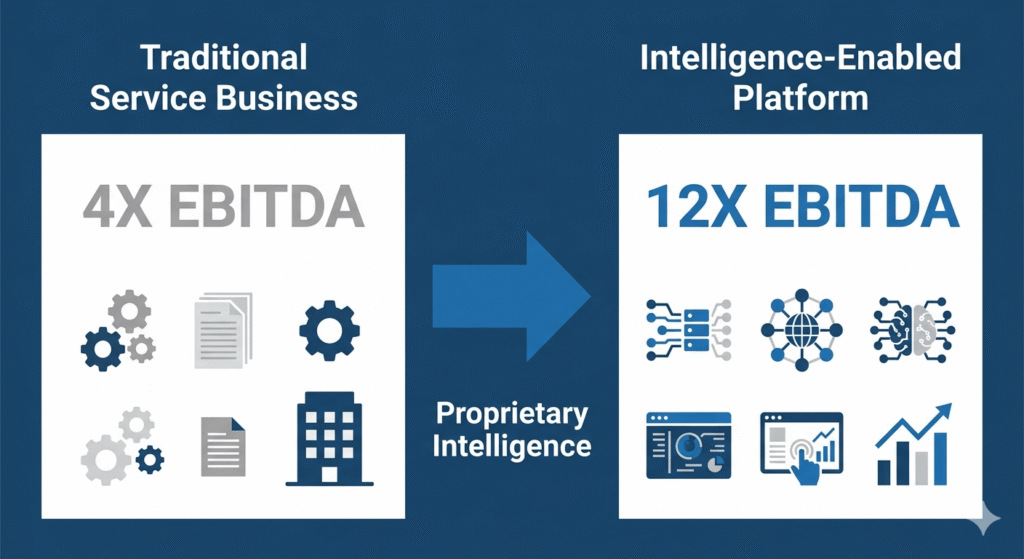
In the context of HVAC business valuation, this single structural shift can move a company from a 4–5X EBITDA multiple into the 8–12X range by redefining how buyers classify the revenue. This creates predictable revenue streams, which are highly valued by buyers.
What this does to your multiple: it converts transactional service revenue into a recurring predictive subscription product. Buyers recognize this as the foundation of a SaaS-structured HVAC platform — and begin applying technology company multiples rather than service company multiples to the recurring revenue layer.
Recurring revenue streams drive sustainable growth and differentiate your business, while high client retention rates, repeat customers, and strong customer lifetime value all contribute to a strong, loyal customer base—a massive asset that signals stability and predictable revenue. High retention shows you deliver consistent value and have built solid relationships, which reduces risk and increases attractiveness to potential buyers.
The system also directly addresses the HVAC labor shortage problem: by routing preventative service intelligently, your technicians spend less time on emergency callbacks and more time on planned, margin-positive maintenance — increasing revenue per technician in a market where Forbes Partners reports 110,000 unfilled technician positions and a projected deficit of 225,000 within five years.
2. Autonomous Dispatch and Routing Intelligence
The difference between an optimized route and a poorly optimized route in a 10-technician HVAC operation can be 15–20% in productivity — which goes directly to the bottom line. Most HVAC dispatch decisions are made by a dispatcher applying judgment and experience. When that dispatcher leaves, the optimization goes with them. Buyers price this operational key-man risk into the acquisition.
Delegating key responsibilities and documenting key processes reduces dependence on specific individuals and makes the business more attractive to buyers. Empowering your team to handle key responsibilities ensures operational continuity and sustainability, which is highly valued by potential acquirers.
A Proprietary Dispatch Intelligence system replaces dispatcher judgment with autonomous intelligence — continuously rebalancing routes based on job duration patterns, technician specialization, geographic clustering, equipment type, urgency classification, and margin profile. The system routes each job to the optimal technician for maximum revenue per hour — autonomously, without human intervention at every step.
What this does to your multiple: it eliminates dispatcher key-man risk, demonstrates operating leverage that is structural rather than personal, and creates a documented operational intelligence system that a buyer can see running in real time. Buyers specifically pay premiums for HVAC businesses where operational performance is a function of intelligence infrastructure, not the judgment of specific individuals who might not stay after the acquisition.
A business that cannot operate without its founder or a few key people is viewed as a high-risk investment, which negatively affects its valuation. Eliminating this dependency is one of the most direct ways to strengthen your HVAC business valuation before going to market.
3. Customer Energy Profile and Equipment Lifecycle Intelligence
Commercial HVAC clients — property managers, facility operators, multi-location businesses — are increasingly required to demonstrate energy efficiency performance. An HVAC contractor that provides ongoing energy intelligence — tracking equipment performance against benchmarks, flagging efficiency degradation before it becomes a compliance issue, and producing investor-grade energy performance reporting for building owners — is delivering a fundamentally different service than one that shows up when something breaks.
A Proprietary Customer Intelligence system accumulates energy usage patterns, equipment performance metrics, and lifecycle data for each commercial client property over time. It produces automated performance reports, identifies upgrade opportunities, and generates proactive maintenance recommendations tied to energy efficiency goals. The client relationship transforms from transactional to advisory — and the switching cost becomes real because the intelligence system holds years of property-specific data that no replacement contractor can access.
What this does to your multiple: it creates genuine customer lock-in — a defensibility that buyers pay significant premiums for. The HVAC businesses commanding 9–11X in the current market are those where customer retention is a function of intelligence infrastructure, not personal relationships with the founder. Customer lock-in of this kind is a documented, measurable factor in any serious HVAC business valuation.
4. Commercial Facilities Intelligence Platform and Intangible Assets — The Path to Tier 3
The most aggressive multiple expansion available to an HVAC business is the licensing of its Proprietary Intelligence to other operators. An HVAC company that has built a commercial facilities intelligence platform — and that licenses it to property managers, commercial real estate operators, or other HVAC contractors in non-competing markets — has crossed from a Tier 2 intelligence-enabled service business to a Tier 3 SaaS-structured platform.
CoolSys is the proof point at scale: a regional HVAC and refrigeration operator that embedded intelligence systems so deeply and so systematically that it became the platform other operators were acquired into, scaling from a regional operator to a $500M+ platform. The intelligence was not just used internally — it became the competitive moat that made CoolSys the most valuable operator in its market.
Most HVAC businesses will not reach CoolSys scale. But the principle applies at any size: an intelligence platform that generates even $200K–$400K in ARR from licensing or subscription revenue changes the buyer’s classification of the business from a service company to a technology platform. That reclassification — from service multiple to SaaS multiple — is worth millions at exit. It is also the single most powerful lever available for HVAC business valuation premium in the current acquisition market.
Market Analysis: Understanding Your Position and Opportunities
A comprehensive market analysis is essential for business owners who want to maximize the value of their service business. By examining current market trends, customer demand, and competitor strategies, you gain a clear understanding of where your business stands and where the greatest opportunities lie. This process often includes a SWOT analysis to pinpoint your strengths, weaknesses, opportunities, and threats.
Market analysis enables business owners to make informed decisions about expanding into new markets, refining service offerings, or investing in innovation. It also helps you anticipate shifts in customer preferences and industry dynamics, so you can adapt quickly and maintain a competitive edge. By staying attuned to market trends and competitor movements, you position your business to capitalize on emerging opportunities and mitigate potential risks—key steps in increasing your company’s value and ensuring sustainable growth. Understanding your market position is foundational to conducting an accurate HVAC business valuation.
Intellectual Property and HVAC Business Valuation: Protecting and Leveraging Your Unique Assets
Intellectual property (IP) is a critical driver of value for service businesses, including HVAC companies. IP encompasses the unique assets that differentiate your business—such as trademarks, copyrights, patents, trade secrets, and proprietary processes or data. Protecting your intellectual property safeguards your competitive advantage, prevents unauthorized use, and preserves your brand reputation.
For business owners, leveraging IP can open new revenue streams through licensing agreements, the development of innovative service offerings, or even strategic partnerships. A well-managed IP portfolio enhances your market position and can significantly expand your customer base, making your business more attractive to investors and buyers. By prioritizing the valuation and protection of your intellectual property, you not only secure your existing assets but also create new opportunities for growth and profitability.
The HVAC Labor Shortage and Intangible Assets: Why Proprietary Intelligence Is Even More Valuable Right Now
The HVAC industry is facing a structural labor crisis that makes Proprietary Intelligence more valuable to buyers today than at any point in the industry’s history. Forbes Partners reports 110,000 unfilled HVAC technician positions in 2025, with a projected deficit of 225,000 technicians within five years. Any serious HVAC business valuation conducted in this environment must treat labor scalability as a primary value driver—not an afterthought.
For buyers, this labor shortage creates a specific due diligence concern: after we acquire this business, can we actually staff it and grow it? A business whose revenue growth is linearly dependent on technician headcount in a market with a chronic technician shortage is a business with a built-in growth ceiling. Buyers price that ceiling into the multiple.
Proprietary Intelligence solves this concern in two ways. First, it increases revenue per technician — by routing intelligently, predicting maintenance proactively, and eliminating non-productive service time — which means the business can grow revenue without proportional headcount increases. Second, it reduces the dependency on any specific technician’s institutional knowledge — because the intelligence system captures and systematizes that knowledge into infrastructure that any competent technician can access.
A business that can demonstrate revenue growth independent of headcount in a market with a documented technician shortage is a fundamentally more attractive acquisition target. Buyers recognize this and price it in.
Blue Dragon’s free AI Valuation Audit takes 8 minutes and gives you a personalized assessment of your current valuation tier, what’s holding your multiple down, and whether Proprietary Intelligence would materially change your exit number. No pitch. No obligation. Just clarity.
Blue Dragon’s Three-Phase Process for HVAC Businesses
The transformation from a Tier 1 service business to a Tier 2 or Tier 3 intelligence platform follows a specific sequence. The valuation process involves multiple steps, including preparing accurate financial statements and documentation to ensure an accurate and credible valuation. Here is exactly how Blue Dragon engineers it:
Before Phase 1 begins, preparing for a valuation involves gathering key financial documents from the last three to five years.
Phase 1: The Blueprint
The Blueprint is the foundation for transformation. A credible valuation is built on a foundation of solid financial data, including profit and loss statements, balance sheets, and cash flow statements. This phase identifies the business’s strengths, weaknesses, and opportunities for improvement.
Organizing documentation and planning for the entire process is essential to ensure a smooth and accurate valuation.
Phase 1: Business Valuation Blueprint — 14 Days
Before a single dollar goes into building anything, Blue Dragon answers the most important question: what specific Proprietary Intelligence concept would materially increase the value of your HVAC business — and is it worth building? The Blueprint produces an investor-grade document package including the intelligence concept design, competitive teardown, valuation multiple modeling (pre- and post-intelligence), IP and defensibility map, and a go/no-go recommendation. The guarantee applies here: if we cannot show a documented path to at least doubling your HVAC business valuation, you receive a complete full refund.
Phase 2: Validation Engine — 45–60 Days
Before significant capital goes into development, the intelligence concept is validated against real market demand. Pricing sensitivity testing, early adopter outreach, pilot interest, and capital readiness assessment. The Validation Engine de-risks the investment by 90%+ and confirms that the intelligence concept has genuine commercial traction before the build begins.
Phase 3: Execution and Scale — 90–180 Days (Invite Only)
For HVAC businesses that pass validation, Blue Dragon’s network of elite engineering partners — three Colombian engineering firms representing 100+ specialized engineers, assembled specifically for each client’s intelligence architecture — executes the full build. The system is built to exit from day one: clean architecture, diligence-ready documentation, and an operational intelligence layer that a buyer can audit, verify, and value.
THE BLUE DRAGON GUARANTEEIf Blue Dragon cannot demonstrate a clear, documented path to at least doubling your current business valuation, we issue a complete full refund. No questions. No conditions. No fine print. No other firm in this space makes this commitment. |
Frequently Asked Questions About HVAC Business Valuation
What is the fastest way to increase my HVAC business valuation before selling?
The highest-impact action is building Proprietary Intelligence that demonstrates recurring revenue and reduces owner dependency — because these are the two factors that most directly move the EBITDA multiple when buyers assess HVAC business valuation. Increasing revenue alone does not change the multiple. Building a predictive maintenance intelligence system that converts transactional service into a recurring subscription product changes the multiple significantly. The process takes 18–36 months to produce the operating history that buyers need to see — which is why starting now is always better than waiting. Common valuation methods for service based companies include earnings multiples, revenue multiples, discounted cash flow, asset based valuation, and market based approaches. Choosing the right method is essential for an accurate service business valuation.
How much does Proprietary Intelligence actually move an HVAC business valuation multiple?
Based on current HVAC transaction data, the gap between a Tier 1 traditional service business (3–5X EBITDA) and a Tier 2 intelligence-enabled business (8–12X EBITDA) is consistently 4–7X. On a $1M EBITDA business, that is a $4M–$7M difference in exit value — from the same revenue. The Forbes Partners 2025 data confirms the high end of the HVAC market (7–11X) is specifically occupied by businesses with documented intelligence capabilities and quality recurring revenue. Buyers and appraisers will pour over your financial statements, looking for predictable revenue streams, healthy profit margins, and stable cash flow. For a live market benchmark, review the current HVAC business valuation multiples for 2026 to see exactly where your company sits against active transaction data.
Does the HVAC technician shortage affect my business value?
Yes — significantly in both directions. A business that is highly dependent on specific technicians and has no operational intelligence infrastructure faces elevated key-man risk in the current labor market. Buyers price this as a post-acquisition operational risk and reduce the multiple. Conversely, a business with Proprietary Intelligence that enables revenue growth independent of headcount increases is specifically more valuable in a labor-constrained environment — because buyers recognize the built-in leverage. Having a dedicated team and strong operational efficiency are also key factors in increasing a company’s valuation.
How do I know which intelligence system to build first?
This is exactly the question Blue Dragon’s Valuation Blueprint answers. The right intelligence concept for your specific HVAC business depends on your revenue mix, customer base, geographic market, and competitive landscape. A residential-heavy HVAC operator might prioritize predictive maintenance and customer lifecycle intelligence. A commercial-heavy operator might prioritize energy profile intelligence and facilities management systems. Blue Dragon designs the specific concept that will move your multiple the most — not a generic framework. Industry trends, growth potential, and market position all influence your company’s ability to generate future earnings.
What if I already tried building technology and it did not work?
This is one of the most common situations Blue Dragon encounters. Most HVAC technology projects fail because they start with execution before answering the question of whether the technology will actually change the valuation. A new customer portal, a mobile app for technicians, a digital dispatch board — these may improve operations without moving the multiple at all. Blue Dragon’s process starts with the valuation question. We only recommend building after answering definitively: will this specific intelligence concept materially increase the exit value of this business? Overestimating future growth can lead to unrealistic financial projections during the valuation process.
How long before I want to sell should I start this process?
Ideally 24–36 months before your target exit date. Buyers need operating history — 12–24 months of a Proprietary Intelligence system running, generating data, and demonstrating financial impact. A system with 24 months of operating history is worth dramatically more at exit than one with 6 months. If you are within 12 months of wanting to sell, Blue Dragon can still add significant value — but the earlier you start, the larger the multiple expansion. Regularly assessing your company’s worth provides clarity for making smarter decisions about growth and operations. The relationship between timing and HVAC business valuation outcome is direct: every additional month of documented intelligence performance is reflected in a higher multiple at exit.
What is the total investment required to go from Tier 1 to Tier 2?
Investment details are discussed after a qualification call to ensure fit on both sides. What Blue Dragon can say: the Valuation Blueprint phase is designed to tell you exactly what the intelligence concept will cost to build and what multiple impact it will produce — before you commit to building anything. The return on a Tier 1 to Tier 2 transition on a $1M EBITDA business is measured in millions of additional exit value. The decision to proceed is always made with full numbers on both sides of the equation. Normalizing financials is essential to provide a clear picture of ongoing profitability.
What factors affect business valuation?
A few key factors that can affect business valuations include profitability, the value of your assets, current market trends, the level of risk in your industry, and the strength of your customer base. Financial performance and stability, growth potential, and the company’s ability to generate future earnings are also critical.
Why is a strong, loyal customer base important for valuation?
A diverse, loyal, and stable customer base that is not overly reliant on a few key people or customers increases valuation by reducing concentration risk. Ensuring no single client accounts for more than 10–15% of total revenue minimizes client concentration risk and demonstrates business stability.
What role do intangible assets play in service business valuation?
Intangible assets, such as brand reputation and customer relationships, play a significant role in the valuation of a service business. Undervaluing intangible assets can lead to a significant underestimation of a service business’s worth.
How do service agreements, customer satisfaction, and high quality services impact value?
Service agreements help create predictable and stable revenue streams, while high customer satisfaction and consistently delivering high quality services enhance brand reputation, customer retention, and overall business value. These factors contribute to increasing profitability and predictable cash flow.
Why is an exit strategy important in business valuation?
An exit strategy is crucial for business valuation and succession planning. Understanding and developing an exit strategy helps maximize business worth, prepares for various exit options, and ensures a smooth transition for owners and investors.
What are the challenges of finding comparable businesses for market based approaches?
Finding relevant market comparisons can be challenging for service businesses due to the unique nature of their offerings. The scarcity of truly comparable businesses can impact the effectiveness of market based approaches in determining fair market value.
Why are standard operating procedures important for valuation?
Standard operating procedures, streamlining operations, and documenting processes enhance business efficiency, scalability, and transferability. These factors make the business more attractive to buyers and support a higher valuation.
What are the benefits of bringing roles in house versus relying on subcontractors?
Bringing roles in house can reduce reliance on subcontractors, improve operational efficiency, and provide better control over service quality, which can positively impact the business’s value.
Why is it important to set realistic expectations and engage a professional valuation analyst?
Setting realistic expectations for your business’s value is essential to avoid inflated or deflated perceptions. Engaging a professional valuation analyst provides an objective perspective and access to industry benchmarks, ensuring a fair market value assessment.
How do innovation, management team, and brand investment affect valuation?
Fostering a culture of innovation, building a strong management team, and investing in brand and marketing all contribute to long-term returns, increased business value, and a stronger market position.
How does customer lifetime and repeat business affect valuation?
A high customer lifetime value and a strong base of repeat customers demonstrate business stability and long-term revenue potential, making the company more attractive to buyers and increasing its valuation.
Conclusion: HVAC Business Valuation and Next Steps
In summary, HVAC business valuation is a vital process for service business owners who want to understand their company’s financial standing and unlock its full potential. By focusing on key factors such as cash flow, customer relationships, financial performance, and intellectual property, you can build a more valuable business that stands out in the marketplace. Conducting a thorough market analysis and protecting your unique assets are essential steps in this journey.
The next steps for business owners involve implementing targeted strategies to improve your business’s value—whether that means investing in growth initiatives, optimizing operations for healthy profit margins, or building a strong management team to ensure stability and future growth. By taking a proactive, informed approach to business valuation, you position your company for financial success, attract potential buyers or investors, and secure a brighter future for your business. Remember, a well-valued business is a valuable business—start making informed decisions today to maximize your company’s worth. Schedule your HVAC business valuation assessment today and know exactly where your multiple stands—and what it will take to move it.

This perspective on HVAC business valuation really shifted my thinking—especially the idea that multiple expansion comes from embedding Proprietary Intelligence rather than just scaling operations. It’s a crucial distinction for owners looking to maximize exit value, not just revenue growth. The emphasis on transforming operational DNA into an intelligence platform makes a lot of sense in today’s market.
Precisely!